The benefits of wind turbines at sea in Belgium: why offshore wind power is a ‘no regret’ solution
Offshore wind power in Belgium is one of the main cornerstones of our electricity supply, as well as one of the most effective ways to ensure our energy security, economic growth and climate policy all stay aligned. In this article, we’re zooming in on Belgium specifically: why is offshore wind so relevant to our country? What are the benefits of wind turbines at sea? And what preconditions must policymakers and market actors fulfil in order to be able to scale up further? Let’s dive in below!
Why is offshore wind power relevant in Belgium?
The challenge facing Belgium is twofold. We need to:
- Decarbonise more quickly given the climate objectives Europe and Belgium have signed up to
- Bolster our local energy security to shield ourselves from spikes in oil and gas prices
That’s why Belgium’s energy transition isn’t just about climate. It’s about security of supply, affordability and economic resilience too.
Investing in offshore wind power offers a particularly compelling answer to this. But why exactly is that the case?
- Belgium possesses an exceptionally good North Sea location with strong, stable winds.
- Belgium has relatively little land available, meaning that large onshore renewable energy projects tend to run into spatial constraints sooner.
- Belgium’s offshore ecosystem is already up and running, with in-depth knowhow and strong suppliers.
What is offshore wind power?
Offshore wind provides kinetic energy that our wind turbines in the Belgian North Sea can convert into electricity. Compared with onshore wind, wind speeds at sea are generally higher and steadier, which is better for energy production. On the downside, the construction of these turbines, their connection to the grid and their maintenance at sea present challenges that are more complex than on land.
How do offshore wind turbines work?
When the wind blows, the blades on our wind turbines start to turn. This rotary motion then drives a generator, which converts the kinetic energy of the blades into electrical power. Finally, cables on the seabed transport the electricity generated to the onshore power grid, which distributes it onward to homes and businesses.
How much offshore wind power can Belgium convert into electricity?
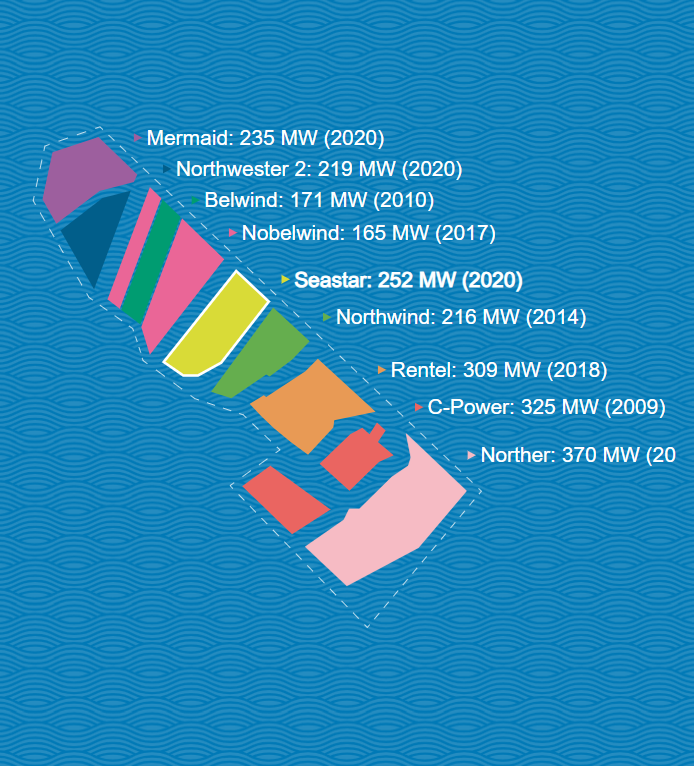
As we speak (in 2026), Belgium has a fully developed initial offshore wind turbine zone with an installed capacity of 2.2 GW, spread across eight wind farms.
Our 2026 production capacity at sea in figures:
- 2,262 MW of Belgian offshore wind capacity
- 8 TWh of self-generated green energy per year
- 10% of total electricity demand in Belgium
Our Belgian offshore wind farms
The Belgian North Sea currently boasts nine seabed leases and eight operational wind farms:
Next step: the Princess Elisabeth Zone
There are plans to develop a second offshore wind turbine zone in the near future: the highly anticipated Princess Elisabeth Zone. Once we start rolling out these plans, we will be able to develop another 3.5 GW of production capacity. This will bring our total installed capacity to 5.7 GW — enough to supply all Belgian households with green energy.
“The Princess Elisabeth Zone must be operational by 2035 at the latest. There is no other way for us to meet our climate objectives and put a stop to rising energy prices. According to a new analysis by the PATHS2050 Coalition, led by EnergyVille, the consequences of the delayed rollout of more offshore wind power are proving to be costly for Belgium. Gas-fired power plants are being used to cover the shortfall. If this goes on, the carbon emissions of the electricity sector will rise by two million tonnes by 2030, and households and businesses will be hit with a hike in their energy bills of between 4% and 7%.”
Bérénice Crabs, Secretary-General of the Belgian Offshore Platform
What are the benefits of wind turbines at sea in Belgium?
Greater security, greater prosperity, greater cost efficiency, greater competitiveness in terms of trade, more green energy and greater circularity. Those are the six benefits of wind turbines at sea and offshore wind power in Belgium.

#1 Greater energy independence and supply security
Offshore wind provides locally generated electricity that we produce and manage ourselves. That way, we can reduce our dependence on imported fossil fuels and reduce our exposure to geopolitical risks and volatile gas and oil prices.
Belgium is highly dependent on imports in terms of energy: approximately 65% of our energy comes from outside of Europe (FOD Economy, 2026). By investing in extra offshore wind capacity, we’re creating more production capacity of our own. That way, we can enhance our security of supply and price stability.
#2 More jobs, greater added value and greater prosperity
Offshore wind not only serves as the core of a major energy project, but also presents an enticing industrial value chain. Over the past few years, the Belgian offshore wind sector has developed into a valuable contributor to our economy.
Our Belgian offshore wind sector offers jobs to 11,000 people and generates an operational profit of €1.4 billion (BE-WISE, 2026). If we develop the Princess Elisabeth Zone on schedule, the sector will be able to create 10,000 extra jobs and contribute €1.5 billion to Belgium’s GDP (Climact, 2021).
#3 Greater cost efficiency and affordable electricity
The cost of wind power has dropped dramatically over the past few years. What’s more, international cost analyses show that renewable energy is generally the cheapest option for new electricity production projects (IRENA: Renewable Power Generation Costs in 2024).
Offshore wind boasts an very low levelised cost of electricity (LCOE), especially when compared with fossil fuels. Even when grid, storage and backup costs are taken into account, an energy system based on renewable sources of energy remains the most cost-effective option. (Fraunhofer)
#4 Greater competitiveness thanks to a strong supply chain
The offshore wind sector in Belgium and Europe can rely on a strong domestic supply chain. Our Belgian businesses operate around the globe, and the European Union is a net exporter of wind turbines, generators and other offshore components. (BE-WISE & Ghent University)
Belgium is in a strong position owing to its expertise in offshore construction and maritime operations, our logistical hubs and ports, and our cluster of experienced developers, investors and suppliers.
#5 More green energy with fewer carbon emissions
Wind power is a crucial technology if we want to reduce the emissions generated by our electricity sector. Our offshore wind turbines not only deliver huge volumes of renewable electricity — they also contribute to the further rollout of greater electrification in other sectors.
An offshore wind farm produces 50 times less CO₂ per kWh than a modern gas-fired power plant. Once installed, wind turbines no longer generate any carbon or other harmful emissions. What’s more, they win back the limited carbon emissions generated during their production and installation within just one year. (WindEurope)
#6 Greater circularity thanks to better end-of-life procedures
Offshore wind turbines and their foundations last for 20 to 30 years, and many last even beyond that. Once they have served their purpose, their components are reused or recycled. Starting from 1 January 2026, the European wind power sector has decided that the blades are no longer allowed to be sent to landfill (WindEurope).
The lion’s share of a wind turbine consists of steel and copper, which is easy to recycle. As far as the composite materials contained in the wind turbine blades are concerned, the sector is developing ever better solutions, such as reuse for innovative and useful projects.
Challenges and preconditions for investing in offshore wind power
More investment in offshore wind is a ‘no-regret’ solution for Belgium: it is local, safe, sustainable and cost-effective. Be that as it may, such investment does carry risks. That’s why — if we want to make sure the further rollout of the Princess Elisabeth Zone can proceed smoothly — we need an investment climate that mitigates these risks.
Which investment risks are there in Belgium?
The Belgian offshore wind sector is faced with:
- Uncertainty about the speed of electrification
- Uncertainty about future demand for electricity
- A high-risk auction framework that deters investors
- Inflated costs due to wars and the energy crisis
- Higher interest rates are pushing up the cost of capital
Which three preconditions need to be met for greater electrificationand energy security?
To realise more offshore wind capacity, we need to fulfil three preconditions:
- Develop a transparent auction framework with predictable tenders
- Strengthen the offshore and onshore electricity grid where necessary
- Minimise any investment risk via two-way Contracts for Difference
Conclusion: offshore wind power is a ‘no regret’ solution for Belgium
The policy message is clear: offshore wind combines six crucial benefits for Belgium, but simultaneously requires a favourable investment climate in which speed, grid development and risk management all play a role. That way, we can make the most of:
- Greater security: security of supply thanks to electricity that’s generated locally.
- Greater prosperity: jobs, added value and a stronger offshore wind sector.
- Greater cost-efficiency: less exposure to price spikes in fuel and CO2
- Greater competitiveness: knowhow we can export and a strong supply chain.
- More green energy: a key lever to help us achieve climate objectives and electrification.
- Greater circularity: ever better solutions for reuse and recycling.
Want to be an ambassador for Belgian Offshore Platform?
Share our one-pager about the six benefits of wind power at sea in Belgium!
Got any questions or want work with BOP?